Saturday, August 31, 2013

Camellias

             
Camellia sasanqua


            Camellias are perfect for filling in the gap between late summer and early spring flowers.  Starting in October, Camellia sasanqua begins a delightful show of rose-like flowers.  Blooming continues through January. Later in the winter season, Camellia japonica starts its show and blooms as late as April. Under ideal conditions, camellias can bloom 6-8 weeks and survive for generations.
       
     Most plantings in my yard were experimental. 19 years after they were planted, my camellias are a success story. I planted 3 Camellia sasanquas in different locations around the house. Due to varying microclimates, each camellia blooms at a different time. This allows us to enjoy each bush individually in its glory. Microclimates are caused by location-related variables that affect plant growth.  Examples are sun and wind exposure, warmth or protection from a brick wall, rain off a gutter, and soil drainage or slope conditions.

     Camellias are available in white and various shades of pink and red.  Select the healthiest plants from reputable suppliers.  New cultivars and hybrids with double blooms and increased winter hardiness may be available.  Alternatively, camellias can self-seed near a mother plant.  Check with your gardener friends to obtain a free plant.


     Camellias are perennial evergreen bushes. Each year the number of flowers increases with the size of the bush.  Keep the future tree-like proportions of a camellia in mind when choosing the planting site.  Like azaleas, camellias prefer acidic soil of 5.5-6.5 and partial shade. Many area soils are naturally acidic, but you can have your soil tested through your county extension office. 

     I have found camellias to be low-maintenance plants.  There is little deer or insect predation.  They grow big enough to offer cover for birds visiting a bird feeder. Place the feeder far enough from the camellia so it can’t be used as a launching pad for squirrels.  Prune wayward branches and unwanted growth after blooming in late winter or early spring.

     If you’re already a camellia owner, take the time to appreciate this winter color, and, if you’re not, plan on obtaining one soon.

This article is an update to one I published in the Franklin Times on January 6, 2012.

Advertising on this blog supports my writing. By clicking an ad, you are under no obligation to buy. If you see an advertisement of interest, please click.


Wednesday, August 28, 2013

Stunning White-marked Tussock Moth Caterpillar


White-marked Tussock Moth Caterpillar


     This colorful caterpillar feeds on a wide-variety of trees. Severe defoliation of trees can sometimes be attributed to this species. An allergic reaction may result from touching the hairs.

There are several caterpillars with "tussock" in the name. This refers to tufts of hair. Their appearance features tufts of hair rather than a uniform covering of hair.

     The White-marked Tussock Moth is related to the Gypsy Moth so a fungus introduced to control the Gypsy may affect the Tussock.

Ipad viewers: see video on you tube.


Advertising on this blog supports my writing. By clicking an ad, you are under no obligation to buy. If you see an advertisement of interest, please click.


Tuesday, August 27, 2013

Saddleback Caterpillar: Beautiful Camouflage and Painful Sting


The Saddleback caterpillar has a striking appearance with a bright green body and a brown saddle. Horns point upward on either end. Spines on the horns and other hairs secrete painful venom.

Ive brushed my leg against a Saddleback and can attest to the discomfort. Upon stinging, the spines can become lodged in the skin which causes more venom to be released and additional irritation. Loose spines can be left on surfaces or be inhaled posing further hazards.


I photographed this specimen on a Japanese maple tree. The caterpillars movements were slow, but deliberate. It's about 1 inch long. The Saddlebacks host plant list is lengthy.

This caterpillar is classified as a slug caterpillar because it does not have prolegs and moves in a sluglike manner. [Prolegs are fleshy protuberances that aid with motion in other caterpillars.] It is the larvae of a brown moth called the Saddleback Caterpillar Moth.

Advertising on this blog supports my writing. By clicking an ad, you are under no obligation to buy. If you see an advertisement of interest, please click.


Thursday, August 8, 2013

My Favorite North Carolina Wildflowers


Asiatic Dayflower


The bloom on the Asiatic Dayflower is only 1/2 inch long. Upon close inspection, it's a beautiful royal blue flower resembling an orchid. The foliage consists of healthy green leaves that tend to be invasive. My crop appears in clusters along my gravel driveway.The name alludes to the fact that blooms appear only during the day .

White Yarrow


I seldom see the blooming on my White Yarrow, but the feathery, fern-like greenery is a favorite of mine. I had a cluster start along my garden gate, and transplanted some of it to other areas. I've heard it described as invasive, but that hasn't been my experience. One of my reference books calls this plant Common Yarrow.


MYSTERY PLANT-CAN YOU IDENTIFY?


This plant has small delicate lavender flowers mounted on top of a triad of fuzzy leaves. It is blooming now (August in North Carolina).


At the base, large leaves lie flat on the ground. A stalk grows about a foot tall and holds the flower stems.


This image shows a group of the flowers clustered among my azaleas.

I have checked my reference materials, and have been unable to identify this plant. It may be in the Plantain family. Please comment on this blog if you know the name. 

Wednesday, July 31, 2013

White-tailed Deer Fawns in North Carolina


We have observed four fawns on three separate occasions in our yard this summer. In all cases, the fawns were alone. I was guilty of having a fantasy idea of deer parentage where the mother stays close to her offspring. This is very far from the truth.

For the survival of the fawn, the mother deer spends very little time with it. Does hide their fawns, return to feed them quickly and leave them alone. This helps the fawns remain scentless-the way they are born, reducing the chance a predator will sniff them out. Once the fawn is strong enough to keep up with the mother, they will forage together.


Sometimes fawns will bleat for their mother. The sound reminds me of a toy car beeping. One year, I heard the beeping sound for a couple of days before spotting the fawn. I thought the young children next door had a new toy.

Many people think a lone fawn is abandoned when this is normal deer behavior. The best response is to stay away from the fawn, allowing the mother to return on her schedule. Try also to keep any dogs from upsetting the fawn.

Other interesting facts:

White-tailed deer have 1-3 young
Twins are often hidden in separate places
Fawns are weaned after 8-10 weeks
Female young stay with the mother for 2 years
Male young leave after 1 year


If you are interested in hearing the fawn’s call, this video has 3 bleats recorded. Sorry for the shakiness and background talking.

Rabbits exhibit the same behavior towards their young. They leave them alone in the nest except to nurse so they remain unscented.

Auburn University has a good publication on fawns.


Thursday, July 18, 2013

Leaffooted Bugs: Bugs all over my Yucca Plant

Their movements were in slow motion so I almost didn't notice the brown and red shapes on the yucca pods adjacent to my deck.

Leaffooted Bugs - the red ones are nymphs


In the enlarged photo above, the leaf shape of the hind leg is visible. These bugs are known for emitting a foul smell when disturbed. They suck plant juices. 

The activity on the yucca pod resembled more of a family reunion than a feeding frenzy. If the individuals moved at all, it was very slow.

Reference:


More birdwatching while on vacation in North Carolina

This year we vacationed between Emerald Isle and Atlantic Beach, North Carolina. We were entertained by some amazing birds.

Barn Swallow


Barn swallows are stunning little birds with forked tails. This one flitted around and under the dock we were standing on, and  posed on a nearby pylon. I've observed barn swallows around lakes as they swoop up insects, and my neighbor has a colony in his old barn. They build mud nests under bridges and in barns. This is the first time, a barn swallow has been still enough for me to photograph. Interestingly, barn swallows migrate to South America for the winter. 

Willet


Small groups of Willets worked the shore looking for tiny crabs. This bird is native to the Eastern Coast of the United States.

Least Tern


Like many other tern species, the Least Tern migrates from South America. They are endangered in many North American locations. We observed this feisty little bird diving into the water after small fish. 

Laughing Gull


The Laughing Gull has a completely black head. They constantly call to each other which I suppose explains the laughing reference.

Tuesday, June 18, 2013

Carolina Wren: A Strange Place for a Nest

The other day, I was surprised to find a bird's nest in our golf cart.


Upon closer inspection, I spotted a small egg.


I went to the house to get my camera.


When I returned, I found a bird incubating the egg.


This is a Carolina Wren. It is common for them to build nests near homes and amongst people things. I have a previous blog about a nest in a milk jug in my greenhouse. Over the years, they have built nests in our winterized sailboat and under the pool cover.

Update: Day 2
The nest contains 5 eggs.


Update: 12 days after the first egg was observed, baby birds are in the nest.
It looks like 3-4 chicks.


Update: We went on vacation and found an empty nest 21 days after the first eggs was observed.

Monday, June 3, 2013

Tick Hotels

Tick Hotels

Along with the beautiful warm days come creepy and dangerous ticks. Our yard seems to have an abundance of them. What do you do when you find a tick crawling on your arm or leg? Grab it and throw it down so it can jump on another family member or pet? No, you want to make sure that tick is not going to live to bother another person.

It's not always convenient to smash the tick with a rock. They are really quite indestructible. I have flushed the little devils, but, they're so ridiculously hardy, I envision them navigating our septic system and resurfacing in the yard. One solution is to make containers we call tick hotels.

These tick hotels are small cosmetic jars and vitamin bottles with lotion in the bottom. We have them labeled and placed strategically in the kitchen, garage, deck, and greenhouse. Once a tick is discovered, it can be dispatched to the nearest tick hotel.The lotion in the bottom of the container slows them down and kills them. Also, it is easier to identify the type of tick with a white background.


Prevention

I'll list some general guidelines that I use to prevent tick bites. There's a lot of specific information available on the topic from experts. If needed, please consult those sources for additional information.

Protect yourself from ticks by spraying insect repellent on your shoes and clothing. Even for a quick walk to the garden, I'll spray my shoes.

For extended stays in long grass, in wooded areas, or other known tick areas wear long pants and liberally spray the lower pant legs and shoes to create a tick barrier.

If possible, remove tick-exposed clothing in a garage or utility room to avoid introducing ticks into the house. Bag the clothing and wash immediately.

Be alert to itchiness or tickling on your skin. These are signs of tick movement. Inspect the itchy area closely. Small ticks resemble freckles. If a tick is found, drop it in the nearest tick hotel.


Friday, May 31, 2013

Herbs I Know????

As a Franklin County Master Gardener, there have been several opportunities to talk to groups about herbs. Unfortunately, I am not a herb expert. My family has ferocious appetites, but no requirements for delicate flavoring. Let's just say that if ketchup were an herb then I might be a herb expert. Growing herbs, therefore, is not a priority in my garden. Growing tomatoes and squash to fill growing kids' bellies has to take priority.

PEPPERMINT

There are a few herbs that are familiar to me.  For years I have let peppermint run rampant around my bay window and deck. These were places with poor drainage where nothing else seemed to grow. The peppermint is winter hardy, and revives with warmer weather. I had heard that rodents avoid peppermint hence the planting around the house foundation. I have flavored my ice tea with peppermint leaves. When my stomach felt off, I have chewed on the leaves. I love the peppermint aroma when I pull up spreading vines.


BASIL

Basil is easy to grow and compliments tomato-based dishes like spaghetti or tomato salad. I have grown it in pots on the deck and alongside vegetables in the garden. It seeds readily so there's almost always baby plants popping up the next year. I have saved dried basil for winter soups and spaghetti sauce.

ROSEMARY


Rosemary is a grass-like herb on a stem. You pull the thin leaves off the stem and flavor chicken or potatoes. There seems to be a trend in using rosemary as a landscape bush.  I can literally pick sprigs of rosemary after I visit the local shopping center.

LAVENDER

The lavender scent has a reputation for encouraging relaxation. It is dried and used in potpourri.  I do like the smell of lavender, but my patch has very little scent.

CHIVES

Chives offer an onion-like flavoring to foods such as baked potatoes. They are easy-to-grow in pots or ground, and return yearly. We rarely use chives so we are rewarded with beautiful purple flowers.


I hope you enjoyed my brief herb summary.

Monday, May 27, 2013

An Easy Garden Fence aka "The Fortress"

Protect your garden from deer by installing an easy fence. Here's how:

1. Drive 10 foot t-posts along the perimeter of the garden. We spaced the posts 10 feet apart. Place the corners first (read step 2). Run a string from corner to corner to line up the t-posts.

t-posts

Use a level to drive the posts in straight.

Use a measuring tape to drive the posts in the same depth. We used 96 inches for our exposed post height.


post driver

2. If desired, use 4 X 4 (inch) wood posts for the corners to add stability. Place the hole in a 16-18 inch hole. Straighten the post with the level. Pour Quikrete or a similar product to hold the post.

corner post

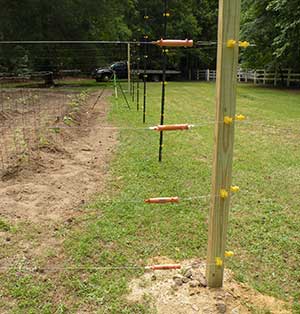
3. After all the posts are in, place the insulators that will hold the wire. We started the bottom wire 9 inches from the ground and subsequent wires 16 inches apart. Our top wire was approximately 7 feet off the ground. (Remember deer are high jumpers :). )

 insulators

4. Run the electrical wire through the insulators around the perimeter. Leave an opening for access and close the wire perimeter with gate handles. This opening can be wide enough for lawnmower or tractor access. It depends on your needs.


gate handles


In the past we have constructed a 4 foot t-post fence and taken it down after the summer garden. This fence has been designed to be permanent so we have allowed for an opening wide enough for a tractor.

One disadvantage of a permanent garden fence is that you can't easily move your garden location if pests get out of control. Moving the garden is an effective pest control method since many garden pests overwinter in the same area.

We have decided to compromise on the insect pest aspect in order to eliminate the deer damage since that has been a huge problem with our vegetable garden. See previous posts about our deer problem.

5. Hook up electric fence to fence charger.We use an electric charger mounted in a small greenhouse near the garden. Alternatively, you can use a solar fence charger mounted in the open.


electric charger

completed fence around garden

Thanks to our dear friends, Mary Pat and Joe, for giving us the t-posts. We appreciate your encouragement and advice on garden fencing.

Tuesday, May 21, 2013

Lamb's Ear: it's a soft thing


Many years ago I took my preschooler sons to the Joel Lane House in downtown Raleigh. We toured the colonial era home and small garden.  The tour guide pointed out the low growing, whitish plant called Lamb's Ear. She explained that because of its softness, it was used as toilet paper.

Later, I succeeded in growing my own Lamb's Ear. This plant is drought hardy and exhibits beautiful pink flowers as early as May. It tends to spread in the garden.

Monday, May 20, 2013

Birds of Spring

We are having a great Spring of bird activity.

There are nesting Eastern Towhees in our backyard Pampas bushes. It has been thrilling to catch glimpses of them popping out of the Pampas or watching the juveniles' short experimental flights. They are cautious nesters. We hardly ever saw the parents fly directly into the Pampas. They would fly into a nearby Camellia, and then swoop low (and undetected?) into the Pampas. Perhaps this circuitous route was intended to elude predators.

Juvenile Towhee

This is the first photograph I've ever taken of a Towhee without a window between the camera and subject. This young one was unsure of his flying skills so he lingered in a tree squawking while I lined up the shot.

 Pampas: Towhee Nesting Site


Bluebird House

For the first time in 16 years, we have baby Bluebirds in a house on our property. The adults have often explored our houses, but never settled in. We are thrilled, and I'll try to get a photograph of the birds.

The fabulous thing about recognizing bird calls is you can identify bird species that are high in the treetops and/or behind foliage.  Some of my favorite species have returned from their South American wintering grounds. I rely on their calls because they are treetop dwellers and nearly impossible to see. This includes the Yellow-billed Cuckoo and the Summer Tanager. Their names are linked to web pages that offer audio of these birds.

Friday, May 10, 2013

Six-spotted Green Tiger Beetle

This insect has a unique and beautiful, metallic green sheen. I found this specimen crawling around in the yard, and noticed that half is outer shell is missing. These are beneficial insects because they eat other bugs.


Note that the actual size of the Green Tiger Beetle is only 1/2 inch.

5/26/13 Update- Second photo added.

Tuesday, May 7, 2013

Termites in North Carolina

Termites swarming on an interior window sill


 Few words strike fear in the hearts of homeowners more than the word "termite." These destructive insects weaken a home from within by eating wood and other cellulose structures.

The destruction by termites is often unnoticed because it is behind walls or under floors. Occasionally, a homeowner will be lucky enough to witness termites swarming.  Swarming only occurs periodically when a large colony needs to split. Special winged termites called swarmers seek out a new location. This is the time to call professionals.

The maintenance of a termite warranty is important. That requires scheduling annual inspections, paying annual fees, and scheduling booster treatments. A termite inspection is almost always required prior to a home sale. Any infestation would be a hindrance to the sale's closing.

More information on termites can be found at the North Carolina Cooperative Extension website.

Friday, May 3, 2013

Many Ants on Peonies

This is the time of year my peony plants become heavy with buds...and ants. Years ago, I had been told that the ants perform a function that helps  the peony blossom. A quick web search indicates this is not true. The ants are enjoying the nectar secreted around the bud.


To avoid carrying ants inside with cut peonies, I carry the vase and a bowl of soapy water outside. I cut the peony knocking off visible ants. Then I take a paper towel dipped in the soapy solution and wipe off any emerging ants.

I place the cut peony(s) in the vase and let it sit outside for 10 minutes. Usually a few ants will come out of the flower. I knock these off with the paper towel. I give the cut peonies another 10 minutes and then take them inside.

Peonies are delightful perennials to have in the garden. Each year, the number of blossoms increases. If your peony is not blooming, the plant may be planted too deep. Peonies prefer a shallow bed. A peony plant can last for generations so it's well worth the initial investment.  The North Carolina Cooperative Extension Service has information about peonies on its website.