Showing posts with label deer. Show all posts

Thursday, July 14, 2016

State of the Garden July 2016

A Cute Fawn Visitor While Gardening - Garden Lady Blog

Vegetables

This year's vegetable garden was started in April. Particularly with the squashes, this gave everything a head start on growth before the insects started cycling through. I've had to pull some plants because of Squash Vine Borer, but, by now, I've had my fill of Crook Neck, Straight Neck, and Zucchini squash. The Spaghetti Squash is growing beautifully up a trellis ( and across to neighboring tomato cages). One vine has borer damage, but it is entangled with healthier plants so I'll have to leave it for now.


Spaghetti Squash gourd on a trellis - Garden Lady Blog

This was my first time growing Bush Beans. They were easy to grow with no insect worries. Simple to cook: prep and wash, cover with water, add salt and boil then simmer for 30 minutes.

Front View of Vegetable Garden - Garden Lady Blog

Cherry Tomatoes have been producing for well over a month. The regular tomatoes are just now turning red at a quick pace. A few plants have wilted, but some of those continue to produce fruit. At this late date, I found my first Hornworm on a green pepper plant. The green peppers have been trouble-free.

Hornworm on Pepper Plant - Garden Lady Blog
Flowers

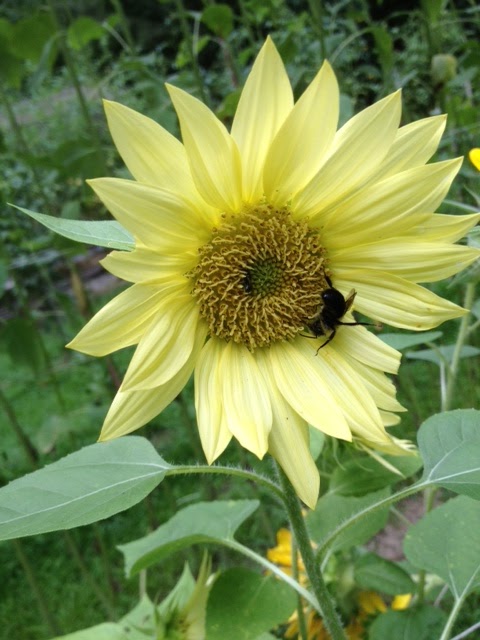
The Sunflowers are a sight to see! There is always a new bloom to admire. Frequent rains have knocked down some stalks so I'm tying them up. To discourage squirrels, I remove the flower after blooming.

Sunflower Bloom - Garden Lady Blog

The Loofah is a running plant like spaghetti squash. It produces beautiful flat yellow flowers. As of yet I haven't seen anything capable of exfoliating on the vine.

Loofah Flower - Garden Lady Blog
The Red Okra produced gorgeous flowers and shiny red fruit. I admired the flowers and gave away the fruit.

Red Okra Flower - Garden Lady Blog
July is a hot month in North Carolina. Fortunately, this year we've been blessed with frequent showers so dragging a sprinkler around trying to save plants is unnecessary. I look forward to winding down the squash harvests and a resurrection of the eggplant. One can hope, right?

I would love to hear your comments about vegetable gardening.

Advertising on this blog supports my writing. By clicking an ad, you are under no obligation to buy. If you see an advertisement of interest, please click.


Monday, August 3, 2015

The Joy of Growing Sunflowers

Sunflowers Make Me Smile - Garden Lady Blog
Sunflowers were something I admired in other people's gardens and in roadside fields. Occasionally one had sprouted near my birdfeeder. The anticipation of seeing the bloom mounted only to be dashed by a grazing deer. This year we grew a patch of sunflowers inside our vegetable garden fence. Protected by an electric current, this garden has been a joy to observe.

In this blog post, I'll share photographs of my sunflowers. The monetary investment was minimal. I planted two Burpee seed packets: Fun 'N Sun Hybrid Mix and Girasol Mammoth variety. I hope you enjoy the photos as much as I've enjoyed and am still enjoying the flowers.

Sunflower Garden - Garden Lady Blog

Mammoths on left; Hybrids on right - Garden Lady Blog
Girasol Mammoth Blooming - Garden Lady Blog

Girasol Mammoth

How tall will they get before blooming? Most of the plants bloomed at 8 - 9 feet. An exceptional plant measured 12 feet! Just before blooming it bent in a graceful arc. Photography without a ladder became possible!


Giant Sunflower - Garden Lady Blog

How Tall Will It Get? - Garden Lady Blog
Measurement of Giant Girasol - Garden Lady Blog

12 Feet Tall! - Garden Lady Blog
Sunflower Curved Gracefully Before Blooming - Garden Lady Blog

Girasol Mammoth Bloom - Garden Lady Blog
Fun 'N Sun Hybrid Mix

The Hybrid Sunflowers started blooming at 3 - 5 feet. Mixes are so interesting because different colors and types of blooms surprise the gardener with every flower.


If you haven't grown sunflowers before, I hope I have convinced you to give it a try. More of my sunflower photography is available at iStock.


Wednesday, July 31, 2013

White-tailed Deer Fawns in North Carolina


We have observed four fawns on three separate occasions in our yard this summer. In all cases, the fawns were alone. I was guilty of having a fantasy idea of deer parentage where the mother stays close to her offspring. This is very far from the truth.

For the survival of the fawn, the mother deer spends very little time with it. Does hide their fawns, return to feed them quickly and leave them alone. This helps the fawns remain scentless-the way they are born, reducing the chance a predator will sniff them out. Once the fawn is strong enough to keep up with the mother, they will forage together.


Sometimes fawns will bleat for their mother. The sound reminds me of a toy car beeping. One year, I heard the beeping sound for a couple of days before spotting the fawn. I thought the young children next door had a new toy.

Many people think a lone fawn is abandoned when this is normal deer behavior. The best response is to stay away from the fawn, allowing the mother to return on her schedule. Try also to keep any dogs from upsetting the fawn.

Other interesting facts:

White-tailed deer have 1-3 young
Twins are often hidden in separate places
Fawns are weaned after 8-10 weeks
Female young stay with the mother for 2 years
Male young leave after 1 year


If you are interested in hearing the fawn’s call, this video has 3 bleats recorded. Sorry for the shakiness and background talking.

Rabbits exhibit the same behavior towards their young. They leave them alone in the nest except to nurse so they remain unscented.

Auburn University has a good publication on fawns.


Wednesday, December 26, 2012

A Visit from the Christmas Deer

On Christmas morning we had a herd of Whitetail Deer visiting our backyard.  The two in the video were enjoying an azalea bush.


The music in the video is Baby by cdk from ccmixter.org.

Monday, November 19, 2012

What is going on with this tree?


Here’s the scenario: a young tree is found with branches broken off and a damaged trunk. What is going on? 


This could be a buck rub. A buck rub is where a male deer has rubbed the top of his head and antlers against a young tree to mark his territory during mating season.


Recent studies  have shown scent glands on the top of the male deer’s head mark their territory as they are pressed against a tree. In the past, it was thought that this was rubbing the velvet off the newly grown antlers.

This damage occurred in November. I’ll report back in the spring on whether or not the Blue Spruce survived.

Friday, July 20, 2012

Deer in the Garden: A Love Hate Relationship


Deer at the Bird Feeders

I am thrilled to see deer meandering through the woods skirting my property. The spotted fawns are so cute. 

Sadly, our electric-fenced vegetable garden was breached by deer that destroyed the pepper plants and defoliated the tomato plants as well as eating entire clusters of cherry tomatoes. The devastation was complete. All that was left was squash and eggplant.
Our 4 foot high 5-strand electrified fence was 3-sided. The 4th side was a wire fence covered with brambles and vines. That was non-electric access into the garden. The other vulnerability is that deer can jump a 4 foot fence.

 My husband was disgusted with the carnage. He threw down a perimeter of tarpaulins reasoning a horse would spook at walking on a tarp so maybe a deer would too.
After the peppers had fresh new growth, the tarps were breached as well, and more destruction ensued. One of the culprits was spotted in the early morning hours, and made his frantic escape losing hair on the non-electric fence.
This time, my solution was to use temporary stakes and add electricity to the 4th side plus a series of wires running parallel through the garden. It’s a labyrinth of wire-both hot and cold. It’s sure to annoy the heck out of the deer, and maybe it’ll keep them from finishing off the struggling plants.

Electrified fence is my answer to deer problems, but now I must amend that with a higher fence requirement. 4 feet is too short, so perhaps 6 or 8 feet will do the trick. I am not a fan of chemical deer sprays because they are expensive and need to be reapplied after rain. I know deer dislike prickly squash so I’ll try planting tomato plants inside a perimeter of squash next year.


Update: August 23, 2012

The labyrinth of wire added to keep the deer out worked! 

Pepper plants that were chewed in half on two different occasions have sprouted peppers to be harvested next week. Likewise, the tomato plants recovered, and we’re looking for things to do with all the tomatoes. After the deer debacle, I let many tomatoes and peppers grow from last year’s dropped seeds, and those plants have also produced tomatoes and jalapeƱo peppers. It’s not the prettiest garden, but it’s yielding wonderful vegetables.

The lesson is to not give up when deer [or bugs] rampage your garden. Come up with creative solutions to keep them out the next time. A garden can recover.

Tuesday, June 12, 2012

Wildlife in the Garden

Bunny reclining in the clover.

Deer helping herself to Virginia Creeper.

Red-eyed Box Turtle.

Black snakes.

Wood lizard on statuary.