Thursday, July 14, 2016

State of the Garden July 2016

A Cute Fawn Visitor While Gardening - Garden Lady Blog

Vegetables

This year's vegetable garden was started in April. Particularly with the squashes, this gave everything a head start on growth before the insects started cycling through. I've had to pull some plants because of Squash Vine Borer, but, by now, I've had my fill of Crook Neck, Straight Neck, and Zucchini squash. The Spaghetti Squash is growing beautifully up a trellis ( and across to neighboring tomato cages). One vine has borer damage, but it is entangled with healthier plants so I'll have to leave it for now.


Spaghetti Squash gourd on a trellis - Garden Lady Blog

This was my first time growing Bush Beans. They were easy to grow with no insect worries. Simple to cook: prep and wash, cover with water, add salt and boil then simmer for 30 minutes.

Front View of Vegetable Garden - Garden Lady Blog

Cherry Tomatoes have been producing for well over a month. The regular tomatoes are just now turning red at a quick pace. A few plants have wilted, but some of those continue to produce fruit. At this late date, I found my first Hornworm on a green pepper plant. The green peppers have been trouble-free.

Hornworm on Pepper Plant - Garden Lady Blog
Flowers

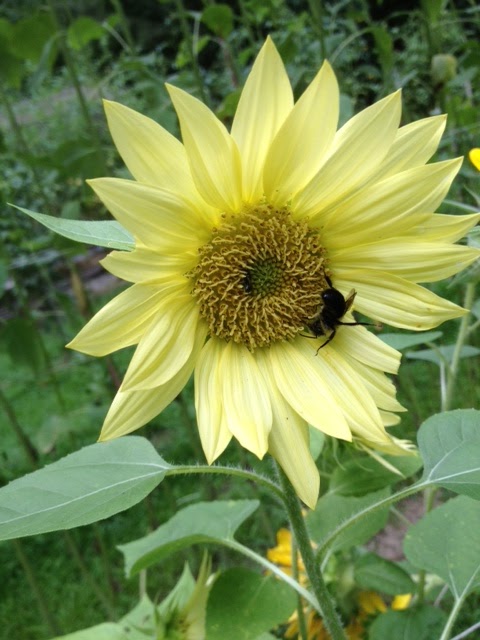
The Sunflowers are a sight to see! There is always a new bloom to admire. Frequent rains have knocked down some stalks so I'm tying them up. To discourage squirrels, I remove the flower after blooming.

Sunflower Bloom - Garden Lady Blog

The Loofah is a running plant like spaghetti squash. It produces beautiful flat yellow flowers. As of yet I haven't seen anything capable of exfoliating on the vine.

Loofah Flower - Garden Lady Blog
The Red Okra produced gorgeous flowers and shiny red fruit. I admired the flowers and gave away the fruit.

Red Okra Flower - Garden Lady Blog
July is a hot month in North Carolina. Fortunately, this year we've been blessed with frequent showers so dragging a sprinkler around trying to save plants is unnecessary. I look forward to winding down the squash harvests and a resurrection of the eggplant. One can hope, right?

I would love to hear your comments about vegetable gardening.

Advertising on this blog supports my writing. By clicking an ad, you are under no obligation to buy. If you see an advertisement of interest, please click.


Saturday, June 4, 2016

State of the Garden June 2016

Front View of Vegetable Garden - Garden Lady Blog


Back View of Vegetable Garden - Garden Lady Blog


Vegetables
Garden planting started much earlier this year. In March I planted snow peas and Brussels sprout seeds. In April we started a bed of blueberry plants. Later that month I planted squash and sunflower seeds. Bush Blue Lake and Harvester beans followed a few days later. The snow peas have been abundant and tasty while ripe blueberries are scarce.

Snow Peas - Garden Lady Blog

Plantings purchased from a nursery included green peppers, jalapeno peppers, tomatoes, and eggplants. Flowering is well underway and peppers and tomatoes are developing. The eggplant has been ravaged by flea beetles so it may be a bad year for them.

Zucchini Squash and Tomatoes - Garden Lady Blog


Green Beans and Tomatoes - Garden Lady Blog


Spaghetti squash was started indoors and transplanted in March. Since it grew over tomato cages one year, I'm training it to climb a trellis. In this way I hope to contain this plant that tends to run all over the garden. It is flowering and small fruit is visible.

Spaghetti Squash Climbing Trellis - Garden Lady Blog

By the way, you may recognize recycled material in use for the 3 trellises. I used railings from old cribs and toddler beds. ( Hey the kids are in college now so why not?)

Sunflower Hybrid Mix - Garden Lady Blog

Flowers

This year's garden includes a wide row of sunflowers: hybrid mix and Mammoths. Another row has seeds from pollinator packets and harvested sunflower seeds from last year. The squirrels had their way with some of the latter, but a whole bunch are sprouting.

Sunflower from Hybrid Mix - Garden Lady Blog

As an experiment, I started Loofah seeds indoors. The transplants are frail so I've lowered my expectations. I think it's good to experiment on one thing in the garden every year, don't you agree? Speaking of experiments, a friend gave me a seed pod from Red Okra. I'm not an okra-lover, but I've heard the flowers are Hibiscus-like and gorgeous so I've have 8 of these seedlings struggling at various locations.

Well that's a summary of activities in the vegetable garden. It hard to believe that I've been writing these State of the Garden articles for 3 years. Last year's can be found here.

With weekly grass cutting and vegetable harvesting, it's going to be a busy summer. I would be interested in hearing about your vegetable gardens. Please comment below!

Advertising on this blog supports my writing. By clicking an ad, you are under no obligation to buy. If you see an advertisement of interest, please click.


Friday, June 3, 2016

4 Favorite Plants that became Invasive

When we first built our home on a 3 acre lot, my gardening goal was to fill up the many bare spots in the landscape with favorite plants. Fast forward 20 years and some of these plants have become invasive. Below I'll describe the plants and how they've worn out their horticultural welcome.

Area Overgrown with Liriope

1 - Liriope

Liriope is also known as Monkey Grass and Creeping Lilyturf. When I first started gardening 30 years ago (at a different property), this was the plant everyone used along sidewalks and driveways as a border. I had no idea that this border plant can morph into a ground cover.

Recent research reveals there is a clumping form(Liriope muscari) and a ground cover(Liriope spicata) species. The ground cover form spreads through underground stems with rhizomes. These rhizomes have the appearance of little bulbs on the roots and are hard to completely remove.

Overgrown liriope is one of the most difficult areas to reclaim. While I was busy raising children, our front yard garden along the house became overrun with it . It provided a hiding place for snakes, rodents, and insects. In the summers, I would mow a path through it to get to the water faucet.

To reclaim this area, we treated the liriope with glycosphate (Roundup) 3 times. Caution was taken to avoid peony and butterfly bushes in the same area. Once the die-off was complete, I covered the area with barrier fabric and topped with mulch. As individual plants sprout through, they are sprayed.

I'm happy with the reclamation. Now I can walk around this area and tend to other plants. Unfortunately, this is not the only area I planted with Monkey Grass...

English Ivy Growing Up a Tree

2 - English Ivy

I admired a friend's groundcover of English Ivy. I couldn't wait to start my own. The ivy has taken over many flat areas as well as climbing trees and the side of our house. It can be killed with glycosphate - a single treatment will do. Once it dies on a brick wall, the vines need to be removed by hand. For ivy growing up a tree trunk, cut the vine at the base of the tree, and pull off what you can.

Periwinkle Vines as Ground Cover

3 - Periwinkle

I'm seeing a pattern here as Periwinkle is another plant that I admired in another yard. It has beautiful lavender flowers even on sunny winter days and attractive variegated leaves. It can create a ground cover and choke out smaller plants. Fortunately, Periwinkle vines are easy to pull up roots and all.

Periwinkle Vines with Flower

"City Block" Forsythia

4 - Forsythia

I have what I call "city block" Forsythia. This is a bush that has expanded over the years to a tremendous size covering up neighbor plants.  Forsythia spreads by sending shoots downward where they attached to the ground and become an independent plant. Severe pruning can get the bush back down to size. Unless roots are dug up, chemical treatment of sprouts will be necessary.

Blooming Forsythia-Woodpecker in Foreground


What about you? What plants have grown out of control in your yard? I would love to hear about it in the comments below.

Advertising on this blog supports my writing. By clicking an ad, you are under no obligation to buy. If you see an advertisement of interest, please click.


Thursday, January 21, 2016

Amazing Facts about Honey Bees


During the first 5 minutes of a tour of Bayer CropScience's Bee Care Center, I learned two things:
  1. Honey bee biology is complex.
  2. Huge numbers of honey bees are required to pollinate crops and produce honey.
The queen honey bee can survive 2-3 years laying 1000-3000 eggs a day. Despite that impressive fertility, she only mates once early in her life cycle. Currently the U.S. almond agribusiness is driving pollination demand. 1.5 million bee hives are needed to pollinate almond crops in California.


Amazing Facts:

  • Honey is naturally antimicrobial and never goes bad.
  • One worker bee produces 1/12 teaspoon of honey in a lifetime.
  • An exclusive diet of royal jelly produces a queen bee.
  • Worker bees transition from one specific job to the next during their short 4-6 week life. 
  • Varroa Mites are visible on a bee's back, and would be "dinner plate size" on a human.
  •  By flying through the air, a bee develops a static charge which attracts pollen.
  • Queen bees exude chemicals that guide the hive's behavior.
  • Stinging causes the death of a honey bee (this is explained here).

Bayer CropScience's Bee Care Center in the Research Triangle Park near Raleigh and Durham, North Carolina, offers tours of their exhibit hall and pollinator research lab. In season, the handling of live hives is demonstrated. Bayer is an agricultural company producing chemicals and seeds for farmers. Their seed crops depend on honey bee pollination. The company produces products to fight plant diseases as well as treatments to neutralize the Varroa mite. This mite is a vector or carrier of 20 different diseases. The colony is weakened by the mite and is less able to meet other challenges to survival.  If you are local to the Raleigh area, the Bee Care Center is an interesting and educational tour (reservations required-see website here).

Bee Hives at NCSU Arboretum
Honey bees enjoying Crocus flowers

Advertising on this blog supports my writing. By clicking an ad, you are under no obligation to buy. If you see an advertisement of interest, please click.


Wednesday, December 30, 2015

Top 5 Viewed Garden Lady Articles


Looking back over 2015, I'm reviewing the top 5 articles that captured the interest of readers. How to Trim Pampas Grass which includes demo videos tops the list with State of the Garden: June at the bottom. Below are short summaries and links to the articles.


Pampas Grass
Some people strongly dislike Pampas Grass. I love the tropical look and drought tolerance of the ornamental grass. This post covers 4 techniques to trim Pampas Grass with videos. See it here.

Northern Cardinal at Bird Feeder

Characters at the Bird Feeder Parts 1 & 2 come in 2nd and 3rd on the list. These articles feature photographs and videos of bird visitors to my backyard bird feeder. Bird Feeder Part 1 is here and Part 2 is here.

Foodborne Illnesses Lead to Recalls

Number 4 in popularity is Good Agricultural Practices (GAP) for Farmers. Guidelines have been established to help farmers reduce contamination leading to foodborne illnesses. Information on these important regulations are here.

Eggplant and Tomato Plants in the Home Garden
State of the Garden: June is Number 5 on the list. This is a narrative of garden goings-on in the month of June. At that time, plants are just getting established and hopes are high for a productive garden. This report is here.

Advertising on this blog supports my writing. By clicking an ad, you are under no obligation to buy. If you see an advertisement of interest, please click.

Saturday, October 3, 2015

Good Agricultural Practices(GAP) for Farmers

Vegetable Harvest - Garden Lady Blog

Center for Disease Control(CDC) data shows in 2013 there were 464 illnesses, 134 hospitalizations, and 3 deaths due to pathogen outbreaks in fruits, nuts, and vegetables. (Source here.)  818 total foodborne disease outbreaks were reported.

As part of the Food Safety Modernization Act (FSMA) farmers have rules to follow to minimize contamination of their product with harmful microbes. Good Agricultural Practices (GAP) should be followed by all along the food growing and handling chain. The regulations give the FDA guidelines and the power to recall harmful product.

Farm produce buyers will expect growers to follow the law.

The following 3-minute video summarizes FSMA which was passed in 2011.


GAP practices are to farming as Good Manufacturing Practices (GMP) are to drug manufacture. Foodborne illnesses are common and the FDA has recently recalled cucumbers for Salmonella, macadamia nuts for Salmonella, spinach for Listeria, mushrooms for Listeria, and soybean sprouts for Listeria.


When exposed to pathogens, people with compromised immune systems, the elderly, and the young are especially prone to serious illness. Written standards like GAP provide necessary guidelines to prevent foodborne disease outbreaks.

The FDA twitter page lists recalls here.

 Advertising on this blog supports my writing. By clicking an ad, you are under no obligation to buy. If you see an advertisement of interest, please click.

Friday, September 4, 2015

Human Behavior and Bugs - The Touchability Factor


Brown Marmorated Stink Bug on Tomato- Garden Lady Blog


Why can I touch one insect, but cower in fear from another?


What makes a bug too repulsive to handle?

In my vegetable garden I pluck stink bugs off tomatoes and drop them in jars of soap water. I've discovered this is the quickest way to get rid of them.
Stink Bug Close Up - Garden Lady Blog
Squash bugs are a slightly longer and faster bug that I need gloves to touch. I pick up centipedes to remove them from the house, and can handle lady bugs. Daddy-longlegs are easy to grab by one long leg and carry out of the house. They are harmless and slow. Most spiders scurry away and are difficult to identify. I wouldn't pick those up.
Squash Bug - Garden Lady Blog

Recently dry weather has driven large wood roaches into my home. These insects fill me with revulsion and fear. Normally a do-it-yourself-er, I called in a pest control company after sighting a half dozen of these. I will not touch them, but, I can squash them under my shoe.

Wasp - Garden Lady Blog

Factors that make a bug too repulsive to touch:

  • Excessive wiggling or other movement (like Japanese Beetles)
  • Danger of stinging or biting (wasps, for example)
  •  Large size (wood roaches)
  •  Unknown Species

6-spotted Green Tiger Beetle - Garden Lady Blog
There are some bugs that I admire very much, but would not touch. Praying mantis, dragonflies, and butterflies are in this group. Years ago I was told handling butterfly wings would damage them permanently. (My article on identifying butterflies found in the southeastern U.S. is here.)

Spicebush Butterfly - Garden Lady Blog

Praying Mantis - Garden Lady Blog
Monarch Butterfly - Garden Lady Blog
I am fascinated by the fact that I touch some bugs and cower in fear from others. What do you think? What is your experience handling bugs? I would love to hear about it. Sincere comments will be published. Anonymous and spam-like posts will be deleted. Have a great day!

If you enjoy photographs of bugs, check out my portfolio at: http://www.istockphoto.com/portfolio/PamSchodt.

Advertising on this blog supports my writing. By clicking an ad, you are under no obligation to buy. If you see an advertisement of interest, please click.

Monday, August 3, 2015

The Joy of Growing Sunflowers

Sunflowers Make Me Smile - Garden Lady Blog
Sunflowers were something I admired in other people's gardens and in roadside fields. Occasionally one had sprouted near my birdfeeder. The anticipation of seeing the bloom mounted only to be dashed by a grazing deer. This year we grew a patch of sunflowers inside our vegetable garden fence. Protected by an electric current, this garden has been a joy to observe.

In this blog post, I'll share photographs of my sunflowers. The monetary investment was minimal. I planted two Burpee seed packets: Fun 'N Sun Hybrid Mix and Girasol Mammoth variety. I hope you enjoy the photos as much as I've enjoyed and am still enjoying the flowers.

Sunflower Garden - Garden Lady Blog

Mammoths on left; Hybrids on right - Garden Lady Blog
Girasol Mammoth Blooming - Garden Lady Blog

Girasol Mammoth

How tall will they get before blooming? Most of the plants bloomed at 8 - 9 feet. An exceptional plant measured 12 feet! Just before blooming it bent in a graceful arc. Photography without a ladder became possible!


Giant Sunflower - Garden Lady Blog

How Tall Will It Get? - Garden Lady Blog
Measurement of Giant Girasol - Garden Lady Blog

12 Feet Tall! - Garden Lady Blog
Sunflower Curved Gracefully Before Blooming - Garden Lady Blog

Girasol Mammoth Bloom - Garden Lady Blog
Fun 'N Sun Hybrid Mix

The Hybrid Sunflowers started blooming at 3 - 5 feet. Mixes are so interesting because different colors and types of blooms surprise the gardener with every flower.


If you haven't grown sunflowers before, I hope I have convinced you to give it a try. More of my sunflower photography is available at iStock.